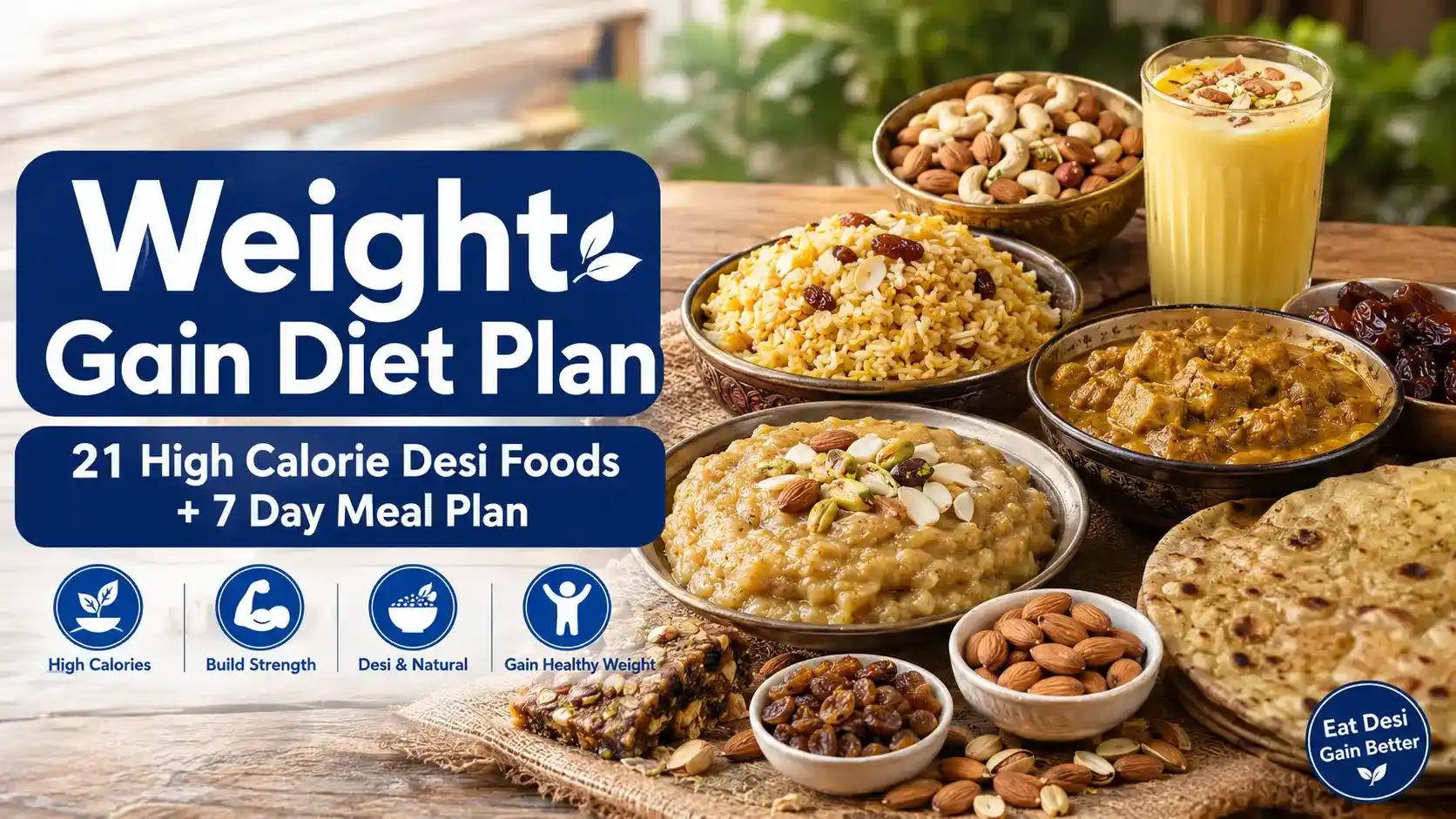
Weight Gain Diet Plan: 21 High Calorie Desi Foods + a 7 Day Pakistani Meal Plan
If you have ever said “main itna khata hoon phir bhi wazan nahi barhta”, you are not alone. Pakistan’s National Nutrition Survey found that 14.5% of women aged 15 to 49 are underweight, and that 21.1% of adolescent boys are underweight compared to 11.8% of girls. Being too thin is just as common here as being overweight.
The problem is usually not your body. It is that a plate of daal chawal, a cup of chai, and a few biscuits do not add up to enough calories in a day.
A good weight gain diet plan fixes that with normal desi food you already eat. This guide gives you the simple maths, 21 high-calorie foods available in every Pakistani market, a full 7-day chart, an Urdu version, separate plans for women, men, kids and babies, and honest answers about how fast you can really gain. Khaalis Zaike is a Pakistani organic food store, and many of our customers use our high calorie foods for weight gain for exactly this purpose.
Weight Gain Meaning in Urdu, and the One Rule That Matters
Quick answer: Weight gain (وزن بڑھانا) means your body stores more energy than it uses. To gain 1 kg of body weight, you need to eat about 7,700 extra calories over time. That is the whole rule.
In Urdu, weight gain is called wazan barhana (وزن بڑھانا). Gaining weight on purpose is sehatmand wazan barhana (صحت مند وزن بڑھانا), which means adding muscle and healthy body weight rather than just fat.
Everything else in this article is simply a way to eat those extra calories without feeling sick or stuffed.
What are the first signs of weight gain?
Quick answer: The first signs are clothes fitting more snugly around the waist and arms, a fuller face, better energy through the day, and the scale moving up by 0.25 kg to 0.5 kg per week.
Weigh yourself once a week, on the same day, in the morning, before eating. Daily weighing is misleading because water and food in your stomach move the number up and down by 1 kg or more.
How Many Calories Does Your Weight Gain Diet Plan Need?
Quick answer: Most underweight Pakistani adults need 2,500 to 3,000 calories a day to gain weight steadily. Start by adding 300 to 500 calories a day on top of what you eat now, and 1.2 to 1.6 grams of protein for every kilogram you weigh.
The NHS advises adding around 300 to 500 extra calories a day for gradual, healthy gain. That is roughly one banana shake plus a spoon of desi ghee in your daal.
Here is a simple target table you can use straight away.
| Your goal | Calories per day | Protein per day | Weight gained per week |
|---|---|---|---|
| Stay the same | 2,000 to 2,200 | 80 to 100 g | 0 kg |
| Slow, lean gain | 2,300 to 2,500 | 100 to 120 g | about 0.25 kg |
| Steady gain (best for most) | 2,500 to 2,800 | 120 to 150 g | about 0.5 kg |
| Fast gain | 2,800 to 3,200 | 150 to 180 g | about 0.75 kg |
A safe rate of gain is about 0.2 kg to 0.9 kg per week. Aim for the lower half of that range. Going faster mostly adds fat, not muscle.
If you have been eating well for two weeks and the scale has not moved, add another 250 calories a day. One extra glass of full cream milk and a spoon of desi ghee will do it.
21 Best Foods for Weight Gain in Pakistan (With Calories Per Serving)
Quick answer: The best foods for weight gain in Pakistan are talbina, panjeeri, jau ka sattu, desi gur, desi ghee, full cream milk, eggs, oats, bananas, dates, almonds, walnuts, cashews, peanuts, potatoes, sweet potatoes, sabudana, mangoes, meat, daal and full cream dairy. Each one packs a lot of calories into a small amount of food.
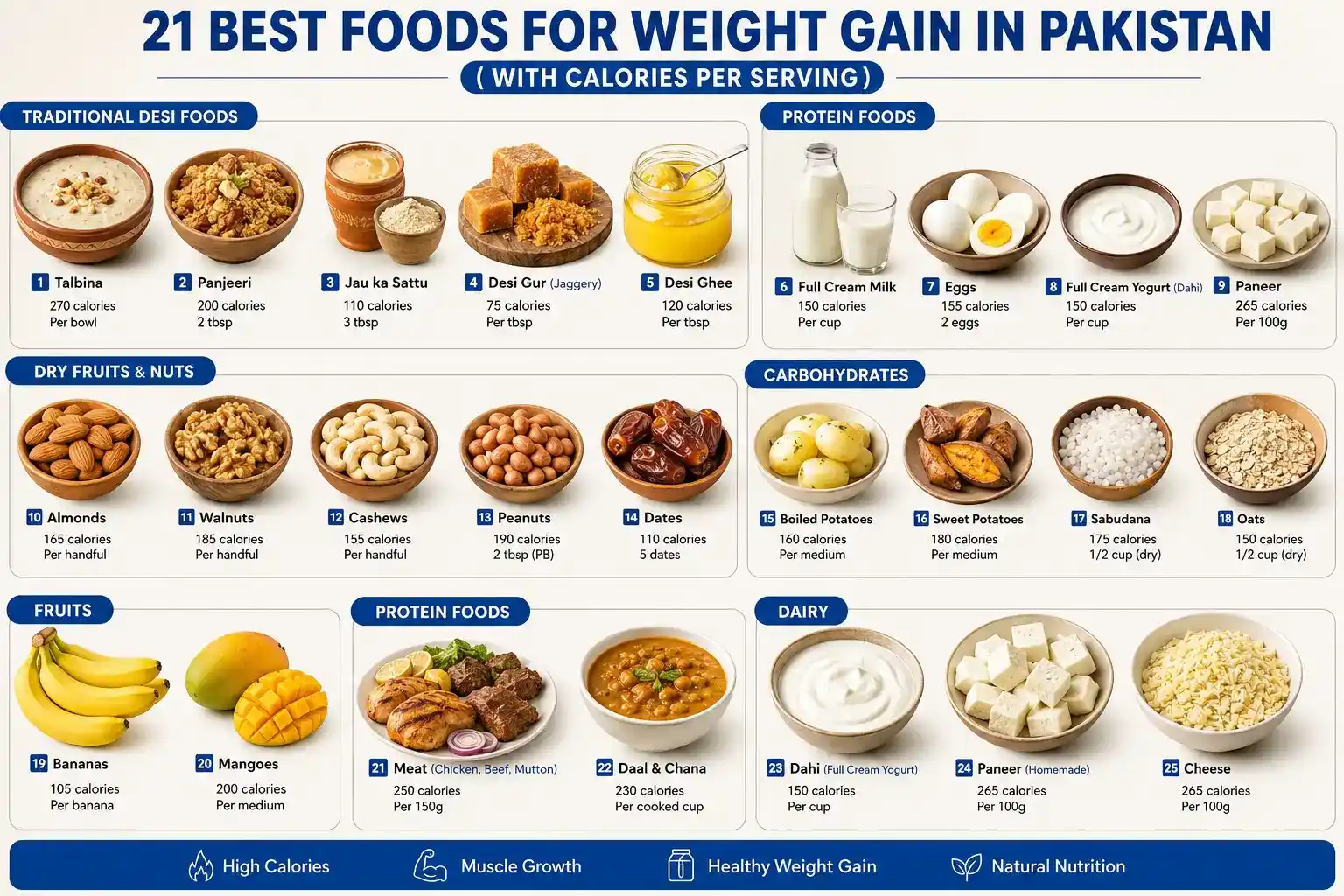
We have put the traditional desi foods first, because these are the ones most weight gain articles skip entirely.
1. Talbina (about 270 calories per bowl)
Talbina is a soft porridge made from barley flour cooked in milk. It is a sunnah food that has been eaten in this region for centuries. Because it is a drink rather than a heavy meal, it slips down easily even when your appetite is poor. One bowl made with full cream milk and a little gur gives around 270 calories.
2. Panjeeri (about 200 calories in 2 tablespoons)
Panjeeri is one of the most calorie-dense foods in any Pakistani kitchen. It is made from wheat flour or semolina roasted in desi ghee, then mixed with nuts, seeds, and gur. Two tablespoons give roughly 200 calories along with iron, calcium, and healthy fats. Our homemade desi panjeeri uses more than 15 nuts and seeds and is rated 4.97 out of 5 from over 186 verified ratings.
3. Jau ka Sattu (about 110 calories in 3 tablespoons)
Sattu is roasted barley ground into powder. Three tablespoons give about 110 calories, and mixed into a glass of milk with gur, it becomes a 300-calorie drink in under a minute. It is cooling in summer, high in fibre, and much cheaper than imported powders. Our jau ka sattu powder holds a 5 out of 5 rating.
4. Desi Gur or Jaggery (about 75 calories per tablespoon)
Gur is an unrefined natural sweetener with iron and minerals still in it. One tablespoon adds 75 calories to milk, sattu, talbina, or porridge. It is a better everyday choice than white sugar because it brings some nutrition along with the calories. Try our organic desi gur, which is made without bleaching agents.
5. Desi Ghee (about 120 calories per tablespoon)
Desi ghee is the easiest calorie boost in Pakistan. One spoon in your daal, one on your roti, and one in your rice adds 360 calories to your day without adding a single extra plate of food. Our pure desi ghee is made from grass-fed cow and buffalo milk with no vegetable oil blending, and it is our highest rated product at 4.99 out of 5 from over 155 ratings.
6. Full Cream Milk (about 150 calories per cup)
Doodh is the simplest way to add calories without feeling full. One cup gives 150 calories and 8 grams of protein. Three cups a day means 450 extra calories and 24 grams of protein. Always choose full cream over low fat when your goal is gaining weight.
7. Eggs (about 155 calories for 2 eggs)
Anday are the cheapest complete protein in Pakistan. Two eggs give 155 calories and 12 grams of protein. Eat the yolk, because that is where most of the vitamins and healthy fat sit. Four to six eggs a day is a normal amount for someone trying to gain.
8. Oats (about 150 calories in half a cup)
Oats are one of the best breakfast bases for weight gain because you can load them up. Half a cup of dry oats is 150 calories, but cooked in full cream milk with gur, banana and almonds it becomes a 550 calorie breakfast. Steel cut or rolled oats are better than instant sachets, which are mostly sugar.
9. Bananas (about 105 calories each)
Kela is the most calorie-dense fruit that is cheap and available all year. At 105 calories each, two bananas a day quietly add 210 calories. Bananas also blend into any shake and are easy to eat when your appetite is low.
10. Dates (about 110 calories for 5 dates)
Khajoor are small but very calorie-dense, and they answer a common question: dates cause weight gain, not loss, when eaten in extra amounts. Five dates give roughly 110 calories along with iron and fibre. Soak them in milk overnight for an easy morning snack.
11. Almonds (about 165 calories per handful)
Badam are the classic Pakistani weight gain food for good reason. One handful of about 28 grams gives 165 calories, mostly from healthy fat. Soak seven to ten almonds overnight and eat them in the morning, which is how most Pakistani households have done it for generations.
12. Walnuts (about 185 calories per handful)
Akhrot are the most calorie-dense nut on this list. A 28-gram handful gives 185 calories plus omega-3 fats that support brain and heart health. Crush them over porridge or panjeeri.
13. Cashews (about 155 calories per handful)
Kaju are softer and sweeter than other nuts, which makes them easier to eat in quantity if you struggle with dry fruit. A handful gives 155 calories.
14. Peanuts and Peanut Butter (about 190 calories in 2 tablespoons)
Peanuts cause weight gain, not weight loss, when you eat them on top of your normal meals. Two tablespoons of peanut butter give 190 calories and 8 grams of protein, and it is the cheapest nut option in Pakistan. Spread it on toast or blend it into shakes.
15. Boiled Potatoes (about 160 calories each)
Aloo are cheap, filling, and easy to digest. One medium boiled potato is 160 calories. Boiled potato with a little ghee, salt and chaat masala is a simple evening snack that adds around 280 calories.
16. Sweet Potatoes (about 180 calories each)
Shakarqandi is roasted on street corners across Pakistan every winter for a reason. One medium sweet potato gives 180 calories plus vitamin A. It is a better carbohydrate choice than plain white rice because it releases energy more slowly.
17. Sabudana (about 175 calories in half a cup dry)
Sabudana is almost pure starch, which makes it very useful for gaining weight. Half a cup dry gives 175 calories. Cooked as khichdi with peanuts and a spoon of ghee, one bowl comes to about 400 calories and is gentle on a weak stomach.
18. Mangoes (about 200 calories each)
Aam causes weight gain when eaten in addition to your meals, which is exactly what you want here. One medium mango gives around 200 calories. In summer, a mango milkshake made with full cream milk is a 400-calorie drink.
19. Chicken, Beef and Mutton (about 250 calories per 150 g)
Meat gives you the protein your body needs to turn extra calories into muscle instead of fat. Chicken thigh is better than breast for weight gain because it has more fat and more calories, and it costs less. Aim for protein at every main meal.
20. Daal and Chana (about 230 calories per cooked cup)
Daal is the most underrated muscle food in Pakistan. One cup of cooked masoor or moong daal gives 230 calories and 18 grams of plant protein, plus iron. Add a spoon of desi ghee on top, and you are at 350 calories for a very cheap bowl.
21. Dahi, Paneer and Cheese (about 150 to 265 calories per serving)
Full cream dahi gives 150 calories per cup. Homemade paneer gives around 265 calories and 18 grams of protein per 100 grams. Both are easy to add to meals you already eat, and both help you hit your protein target without more meat.
Ready to stock your kitchen? Browse our full range of high calorie foods for weight gain with free shipping across Pakistan and cash on delivery.
High Calorie Drinks and Weight Gain Milkshakes
Quick answer: The best drink for gaining weight is a homemade milkshake made with full cream milk, banana, nuts, and either panjeeri or sattu. One glass can give 400 to 550 calories, which is easier to swallow than an extra plate of food.
Drinks are the single best trick for anyone with a small appetite. Your stomach accepts liquid calories far more easily than solid ones. Have them between meals, never right before a meal, or you will not be hungry when the food arrives.
Panjeeri Banana Shake (about 550 calories)
Blend 1 cup full cream milk, 1 banana, 2 tablespoons of panjeeri and 1 tablespoon of peanut butter. This is the most calorie-dense drink on the list, and it tastes like a dessert. Have it mid-morning or straight after training.
Talbina with Gur (about 450 calories)
Cook 3 tablespoons of barley flour in 1.5 cups of full cream milk, then stir in 1 tablespoon of gur and a few crushed almonds. Warm, easy to digest, and good for people whose appetite is very weak.
Sattu and Date Shake (about 400 calories)
Blend 3 tablespoons of jau ka sattu, 1 cup of full cream milk, 4 soaked dates, and 1 teaspoon of desi ghee. This takes one minute and costs a fraction of an imported shake.
What about weight gain milk powder?
Packaged weight gain milk powders are mostly milk solids, sugar and maltodextrin. They work, but you are paying a high price for calories you can get from milk, gur and sattu at home. Use them for convenience, not because they do something food cannot.
The 7 Day Weight Gain Diet Plan (About 2,800 Calories a Day)
Quick answer: This 7-day weight gain diet plan uses normal Pakistani meals and gives roughly 2,650 to 2,950 calories a day, which is enough for most adults to gain about 0.5 kg a week. It has five eating occasions a day: breakfast, mid-morning, lunch, evening and dinner.
Every day below is genuinely different, so you will not get bored by Wednesday.
| Day | Breakfast | Mid morning | Lunch | Evening | Dinner | Total |
|---|---|---|---|---|---|---|
| 1 | 2 parathas in desi ghee, 2 fried eggs, 1 glass full cream milk | Panjeeri banana shake | Chicken pulao with 1 cup dahi | 1 banana and 20 almonds | 2 rotis with ghee, 1 cup daal, salad | ~2,950 |
| 2 | Oats in milk with peanut butter and banana | 2 boiled eggs and 5 dates | 2 rotis with ghee, chicken karahi, salad | Sattu and date shake | 1 cup rice, 1 cup daal with ghee, 1 glass milk | ~2,700 |
| 3 | Talbina with gur and almonds, 1 boiled egg | 1 mango and a handful of kaju | Beef curry, 2 rotis with ghee, dahi | Peanut butter toast with milk | Sabudana khichdi with 1 glass milk | ~2,650 |
| 4 | Anda paratha in ghee, chai with full cream milk | Panjeeri banana shake | Chicken biryani with raita | Boiled potato chaat and 6 walnut halves | 2 rotis with palak paneer | ~2,950 |
| 5 | Oats cooked in milk with gur and walnuts | 2 boiled eggs and 1 banana | Mutton qorma, 1 cup rice, salad | Sattu and date shake | 2 rotis with ghee, chana daal, dahi | ~2,760 |
| 6 | 3 egg omelette with cheese, 2 toasts with butter, milk | Roasted shakarqandi with a little gur | Fish or chicken, 1.5 cups rice, daal | Talbina | 2 rotis with ghee and keema | ~2,900 |
| 7 | Paratha with desi makhan, 2 boiled eggs, milk | Mixed dry fruits and 5 dates | Chicken pulao with dahi | Panjeeri with warm milk | 2 rotis, daal with ghee, salad | ~2,850 |
How to use it: Do not skip the mid-morning and evening slots. Those two snacks are where roughly 800 of your daily calories come from, and they are the first thing people drop when they get busy.
Weight Gain Diet Plan in Urdu (اردو میں وزن بڑھانے کا چارٹ)
Quick answer: یہ ایک دن کا سادہ چارٹ ہے جو تقریباً 2,900 کیلوریز دیتا ہے۔
| وقت | کیا کھانا ہے |
|---|---|
| ناشتہ | دو پراٹھے دیسی گھی میں، دو انڈے، ایک گلاس فل کریم دودھ |
| گیارہ بجے | کیلے اور پنجیری کا شیک |
| دوپہر کا کھانا | چکن پلاؤ اور ایک پیالی دہی |
| شام | ایک کیلا اور بیس بادام |
| رات کا کھانا | دو روٹی دیسی گھی کے ساتھ، ایک پیالی دال، سلاد |
روزانہ تین وقت کھانا اور دو بار اسنیکس لینا ضروری ہے۔ ہفتے میں ایک بار وزن چیک کریں۔
How to turn this into a 10 kg weight gain diet chart
Quick answer: Gaining 10 kg needs about 77,000 extra calories in total. At 500 extra calories a day, that takes around 5 months. At 750 extra calories a day, it takes around 3.5 months.
No 10 kg chart works in a month. Follow the 7-day plan above, weigh yourself weekly, and add 250 calories whenever your weight stalls for two weeks in a row.
Weight Gain Plans for Women, Men, Kids and Babies
Quick answer: The rules are the same for everyone, only the calorie amounts change. Women usually need 2,200 to 2,600 calories a day to gain; men need 2,600 to 3,200; and children need smaller, more frequent meals rather than bigger ones.
Weight gain diet plan for females
Most women need about 300 to 400 fewer calories than men to gain at the same rate. Follow the 7-day chart above but reduce rice and roti portions by about a quarter, and keep all the shakes and snacks in place. Iron matters here, because anaemia affects around 41% of Pakistani women aged 15 to 49 and low iron kills appetite. Daal, gur, dates, panjeeri and red meat all help.
Supplements for weight gain for females are the same as for men. There is no special female formula. What women often need more of is iron, calcium and vitamin D, so ask a doctor for a blood test before buying anything.
What causes rapid weight gain in females?
Quick answer: Sudden, unplanned weight gain in women is usually caused by thyroid problems, PCOS, fluid retention, certain medicines, stress, or poor sleep. It is not the same thing as gaining weight on purpose.
See a doctor if you gain around 5% of your body weight in a month without changing how you eat, or if you notice swelling in your feet, ankles, or face. The Cleveland Clinic advises seeing a provider for rapid gains of this kind, because they can point to a treatable medical cause.
Weight gain diet plan for male
Men gaining weight should follow the full 7-day chart without reducing portions, and add one extra glass of full-cream milk at bedtime. Because men typically build muscle faster, protein matters more here: aim for 1.6 grams per kilogram of body weight. A 60 kg man needs about 96 grams of protein a day, which is roughly 4 eggs, 200 grams of chicken, 2 cups of daal and 3 glasses of milk.
Weight gain diet plan for kids
Children do not need a diet chart so much as calorie upgrades to the food they already accept. Add desi ghee to their daal and rice. Give full cream milk instead of tea. Offer panjeeri, dates, banana shakes, and boiled eggs as after-school snacks. Never force-feed a child, because it usually makes them eat less over time, not more.
Food for a 6-month baby to gain weight
Quick answer: At 6 months, breast milk or formula must remain the main source of nutrition. Solids are an addition, not a replacement. Good first foods for weight gain are mashed banana, soft khichdi, daal water, mashed potato, and rice cereal, each with a small amount of desi ghee.
Two important safety points. Do not give honey before the age of one. Do not give cow or buffalo milk as a main drink before the age of one. Always check with your paediatrician before changing what your baby eats, especially if weight gain is slow.
The best milk for a baby to gain weight under one year is breast milk, or a formula recommended by your paediatrician. After one year, full cream milk is appropriate.
Supplements, Powders, Herbs and Weight Gain Medicine
Quick answer: No supplement works better than food for weight gain. Protein powders and mass gainers are a convenience for people who cannot eat enough, not a shortcut. Fix your meals first, then decide if you still have a gap to fill.
Which is the best supplement for weight gain?
The honest answer is full cream milk. It gives calories, protein, calcium, and vitamin D; it costs a fraction of any powder, and it is available on every street. If milk alone is not closing your gap, panjeeri and sattu do the same job as a mass gainer using real ingredients rather than maltodextrin.
Best protein powder for weight gain
Protein powder adds protein, not calories. That is the mistake most people make. A scoop of whey gives 25 grams of protein but only about 120 calories, which is less than a spoon of ghee. If you are eating meat, eggs, daal and milk daily, you probably do not need it. If you are vegetarian or you train hard and cannot hit your protein target, one scoop a day is a reasonable addition.
Weight gain powder and mass gainer are different products. Those are mostly carbohydrates and can run from ₨19,000 to ₨32,000 for a tub in Pakistan. You can build the same calories at home for a fraction of that.
Herbs for weight gain
Some traditional herbs support appetite and strength, but none of them add weight on their own. Moringa, known here as sohanjna, is very nutrient dense and useful if your diet is poor, though it is not a calorie source. You can find our moringa powder here. Ashwagandha has some evidence for supporting strength when combined with weight training. Treat herbs as a support, never as the plan.
Multivitamins, Ensure, and weight gain medicine
A multivitamin does not cause weight gain. It only helps if you have a deficiency that is suppressing your appetite, and a blood test will tell you that. Meal replacement drinks such as Ensure were designed for patients recovering from illness, and they work, but a homemade sattu or panjeeri shake gives similar calories at a much lower cost.
Be careful with anything sold locally as weight gain medicine. Appetite stimulants and steroid-based tablets are widely available in Pakistan without proper prescriptions, and they carry real risks to your liver, hormones, and heart. Any medicine that increases weight should come from a doctor who has examined you, not from a shop counter.
Weight Gain Workout: Turning Calories Into Muscle
Quick answer: Lift weights three to four times a week using compound movements, and keep cardio light. Without resistance training, most of the extra calories you eat will be stored as fat instead of muscle.
Focus on a small number of exercises and get stronger at them: squats, push-ups, rows, deadlifts, overhead press, and pull-ups. Three sets of six to ten reps each is enough. Try to add a little weight or one more rep every week, because that steady progress is what actually signals your body to build muscle.
Keep running and long cardio to a minimum while you are gaining, since it burns the calories you are working hard to eat. Walking is fine and helps appetite. Sleep 7 to 8 hours, because muscle is built while you rest, not while you train.
How Fast Can You Realistically Gain Weight?
Quick answer: A safe and realistic rate is 0.25 kg to 0.5 kg per week. Gaining 1 kg needs about 7,700 extra calories, so 2 kg in 7 days would require around 2,200 extra calories every single day on top of your normal food.
This table answers most of the questions people search for.
| Goal | Total extra calories needed | Realistic time |
|---|---|---|
| 1 kg | 7,700 | 2 to 4 weeks |
| 2 kg | 15,400 | 4 to 8 weeks |
| 3 kg | 23,100 | 6 to 12 weeks |
| 5 kg | 38,500 | 3 to 5 months |
| 10 kg | 77,000 | 5 to 10 months |
How to gain 2 kg in 7 days
It is technically possible to see 2 kg more on the scale in a week, but most of that number is water, glycogen, and food sitting in your gut, not real tissue. Real weight gain of 2 kg takes four to eight weeks. If someone promises it in seven days, they are describing a number on a scale, not a change in your body.
Can I gain 5 kg in a month?
Not in a healthy way. 5 kg needs 38,500 extra calories, which is around 1,280 extra calories every day for 30 days. Even if you managed to eat that, most of the gain would be fat. Three to five months is the realistic answer for 5 kg.
How to gain 20 kg in 1 week
This is not possible. 20 kg would need 154,000 extra calories in seven days, which is about 22,000 extra calories a day. No human can eat that, and attempting it would make you seriously ill. Set a 12-month target for 20 kg instead.
How to gain weight on your face in 7 days
You cannot choose where your body adds weight. The face fills out on its own as your overall weight rises, usually after the first 2 to 3 kg. In the short term, drinking enough water, sleeping well and cutting back on very salty food will make your face look fuller and less drawn.
How to gain weight in 7 days at home
Seven days is enough to build the habit, not the body. Use week one to lock in five eating occasions a day, add one shake, put desi ghee on three meals, and start lifting. Do that consistently and the weight follows in weeks two to eight.
9 Weight Gain Tips That Actually Make a Difference
Quick answer: Eat five times a day, drink your calories between meals, add desi ghee to everything, never skip breakfast, lift weights three times a week, and weigh yourself only once a week.
- Eat five times a day, not three. Three big meals are hard to finish. Five smaller ones are easy.
- Drink water between meals, not with them. A full glass of water at the table means less room for food.
- Add one spoon of desi ghee to three meals daily. That is 360 extra calories with zero extra effort.
- Never skip breakfast. A missed breakfast is 600 calories you will not get back later in the day.
- Keep a shake ready. On busy days, one glass replaces a missed meal.
- Choose full cream over low fat. Milk, dahi and cheese should all be full cream while you are gaining.
- Eat protein at every meal. Eggs, daal, meat or dahi, every single time.
- Lift weights three times a week. This decides whether you gain muscle or fat.
- Weigh weekly, not daily. Daily numbers will only discourage you.
Five mistakes to avoid: relying on samosas, biscuits and fizzy drinks for calories; doing lots of cardio while trying to gain; drinking too much chai and losing your appetite; giving up after two weeks; and buying supplements before fixing your meals.
Frequently Asked Questions
What should I eat to gain weight quickly?
Eat calorie-dense foods on top of your normal meals: full cream milk, desi ghee, panjeeri, nuts, dates, bananas, eggs, daal and meat. Add one homemade shake a day between meals. The fastest safe approach is a 500-calorie daily surplus, which gives about 0.5 kg per week.
Which fruit is best for weight gain?
Bananas, mangoes and dates are the best fruits for weight gain because they carry the most calories per bite. One banana is 105 calories, one mango is about 200, and five dates are around 110. Eat them as extras between meals rather than as food replacements.
What is the best breakfast for weight gain?
The best breakfast for weight gain is oats cooked in full cream milk with gur, banana and nuts, or two parathas made in desi ghee with two eggs and a glass of milk. Both come to 550 to 800 calories, which sets up your whole day.
Which dry fruit is best for weight gain?
Walnuts (akhrot) give the most calories per handful at around 185, followed by almonds at 165 and cashews at 155. A mix of all three is better than one alone, since each brings different fats and minerals. A daily handful adds roughly 170 calories.
Is talbina good for weight gain?
Yes. Talbina is easy to digest, made with milk and barley, and gives around 270 calories per bowl. It is especially useful for people whose appetite is weak or who are recovering from illness, since it goes down as a drink rather than a heavy meal.
Do I need a gym to gain weight?
No. You need resistance training, and that can be done at home with push-ups, squats, lunges, planks, and a few resistance bands or a pair of dumbbells. The gym makes progress easier to measure, but the food is what actually adds the weight.
Start With Real Food
Three things decide whether this works. First, a calorie surplus of 300 to 500 a day, tracked with a weekly weigh-in. Second, protein at every meal so the extra calories build muscle instead of fat. Third, patience, because 0.5 kg a week is the honest rate and anything faster is mostly fat or water.
You do not need imported powders to follow a weight gain diet plan. The foods that have helped Pakistani households gain healthy weight for generations are still the best ones: desi ghee, panjeeri, sattu, gur, milk and dry fruits.
Every Khaalis Zaike product is made by hand in small batches, with no artificial preservatives, colours or fillers, and sourced from trusted Pakistani farms.
This article is general nutrition information, not medical advice. If you are underweight, losing weight without trying, or have a medical condition, please speak to a doctor or a qualified nutritionist before making big changes to your diet.