Top 50 Fiber-Rich Foods in Pakistan: Complete Chart + Urdu Guide
Most adults in Pakistan eat far less fiber than their body needs. A clinical study published in the Pakistan Journal of Medical & Health Sciences found the average daily intake sits around 18.7 grams, well below the recommended 25 to 38 grams. Fiber, known as فائبر or ریشہ دار غذا in Urdu, is the part of plant food your body cannot digest, and it quietly protects you from constipation, high cholesterol, and blood sugar spikes.
The good news? Fiber-rich foods are already sitting in your kitchen. From daal and amrood to jau ka sattu, Pakistan’s desi diet is full of them. In this guide from Khaalis Zaike, Pakistan’s trusted organic food store, you will find 50 fiber-rich foods with Urdu names, a complete fiber chart, and practical fixes for constipation, breakfast, and low-fiber diets.
What Is Fiber? Meaning in Urdu (فائبر کیا ہے؟)
⚡ Quick Answer: Dietary fiber (Urdu: فائبر یا ریشہ دار غذا) is a plant-based carbohydrate the human body cannot digest. Instead of being absorbed, it passes through the gut, adding bulk to stool, feeding good bacteria, and slowing sugar absorption. Adults need 25 to 38 grams of fiber daily.
In everyday Urdu, fiber is simply called فائبر, while dietary fiber translates to غذائی ریشہ or ریشہ دار غذا. Any food described as ریشے والی غذا, such as daal, sabzi, whole wheat roti, and fruit with the skin on, is a fiber food.
Unlike protein or fat, fiber is not broken down for energy. Its job is mechanical and biological: it keeps your digestive system moving and your gut bacteria fed.
Soluble vs Insoluble Fiber
There are two types of fiber, and you need both:
- Soluble fiber dissolves in water and forms a gel. It lowers cholesterol and steadies blood sugar. Desi sources include ispaghol, jau (barley), oats, and apples.
- Insoluble fiber does not dissolve. It adds bulk to stool and prevents constipation. Think whole-wheat atta with chokha, bhindi, and vegetable skins.
Most whole foods contain a mix of both, which is why nutritionists recommend food first and supplements second.
How Much Fiber Per Day Do You Need?
⚡ Quick Answer: Women need about 25 grams of fiber per day and men need about 38 grams, according to dietary guidelines cited by GoodRx. Most Pakistanis consume under 19 grams, which is roughly half the male requirement.
To picture 30 grams: one cup of cooked daal (15.6 g) plus one amrood (9 g) plus two whole wheat rotis (6 g) gets you there in a single day. It is easier than it sounds once you know which foods carry the most fiber.
Fiber Rich Foods Chart (List of High Fiber Foods)
⚡ Quick Answer: The highest fiber foods commonly available in Pakistan are split lentils (15.6 g per cooked cup), chickpeas (12.5 g per cup), chia seeds (10 g per 2 tablespoons), guava (9 g per fruit), and oats (8 g per cooked cup).
Here is a complete fiber-rich foods chart with Urdu names and fiber per serving:
| Food | Urdu Name | Serving | Fiber (g) |
|---|---|---|---|
| Lentils (cooked) | دال | 1 cup | 15.6 |
| Chickpeas | چنے | 1 cup cooked | 12.5 |
| Black-eyed peas | لوبیا | 1 cup cooked | 11.0 |
| Kidney beans | راجما | 1 cup cooked | 11.4 |
| Chia seeds | چیا سیڈز | 2 tbsp | 10.0 |
| Guava | امرود | 1 medium | 9.0 |
| Green peas | مٹر | 1 cup cooked | 8.8 |
| Oats | جئی | 1 cup cooked | 8.0 |
| Roasted chana | بھنے چنے | ½ cup | 8.0 |
| Barley | جو | 1 cup cooked | 6.0 |
| Sweet potato | شکر قندی | 1 cup cooked | 6.0 |
| Whole wheat roti | گندم کی روٹی | 2 rotis | 6.0 |
| Flax seeds | السی | 2 tbsp | 5.6 |
| Pear | ناشپاتی | 1 medium | 5.5 |
| Psyllium husk | اسپغول | 1 tbsp | 5.0 |
| Broccoli | بروکلی | 1 cup cooked | 5.0 |
| Apple (with skin) | سیب | 1 medium | 4.4 |
| Spinach | پالک | 1 cup cooked | 4.3 |
| Almonds | بادام | ¼ cup | 4.0 |
| Carrots | گاجر | 1 cup raw | 3.6 |
Save this chart. Building a 25 to 38 gram day becomes simple when you combine two or three foods from the top half of the table, a strategy the Mayo Clinic also recommends for hitting daily fiber goals.
Top 10 Fiber Foods (Quick List)
⚡ Quick Answer: The top 10 fiber foods in Pakistan are:
1) Daal
2) Chanay
3) Amrood (guava)
4) Chia seeds
5) Oats
6) Jau (barley)
7) Whole wheat roti
8) Ispaghol
9) Badam (almonds)
10) Alsi (flax seeds)
If you only remember ten foods from this entire guide, make it these. Together they cover soluble fiber, insoluble fiber, protein, and healthy fats, and every single one is available in local markets across Pakistan.
50 Fiber Rich Foods in Pakistan (By Category)
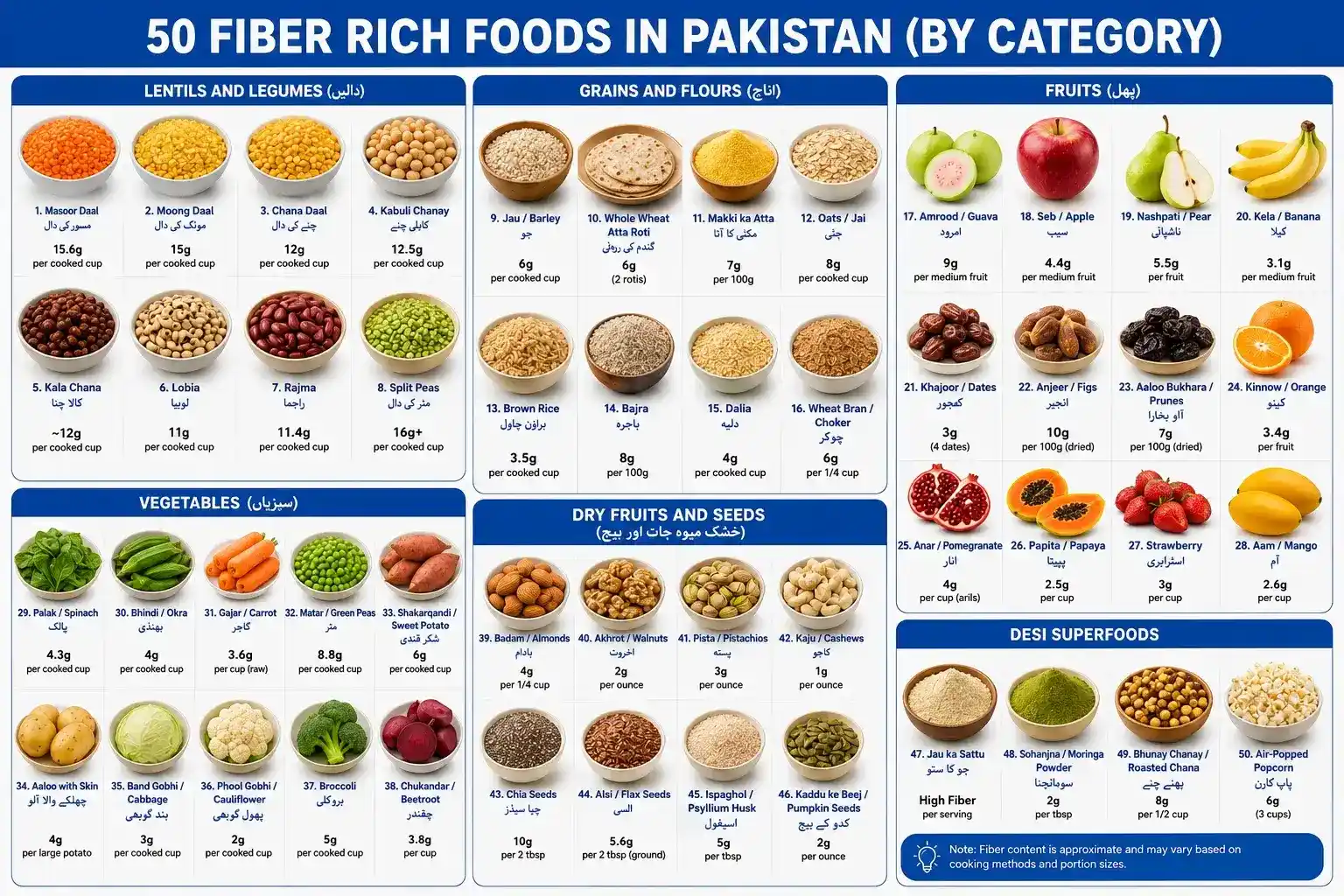
This is the most complete list of high-fiber foods in Pakistan, organised by category with Urdu names and fiber per serving.
Fiber Rich Lentils and Legumes (دالیں)
1. Masoor Daal (مسور کی دال) — Red lentils deliver 15.6 grams of fiber per cooked cup, more than half your daily target in one bowl. Pair with roti for a complete, gut-friendly meal.
2. Moong Daal (مونگ کی دال) — The gentlest daal on the stomach still packs around 15 grams per cooked cup. Ideal for children, the elderly, and anyone recovering from illness.
3. Chana Daal (چنے کی دال) — Slow-digesting and hearty, chana daal provides about 12 grams of fiber per cup along with steady, long-lasting energy.
4. Kabuli Chanay (کابلی چنے) — White chickpeas offer 12.5 grams per cooked cup. From chana chaat to murgh cholay, they are the easiest fiber upgrade in Pakistani cuisine.
5. Kala Chana (کالا چنا) — Black chickpeas are even higher in fiber than white ones because the skin stays on. Boiled kala chana with lemon and onion makes a filling high-fiber snack.
6. Lobia (لوبیا) — Black-eyed peas carry roughly 11 grams of fiber per cooked cup plus plant protein and iron.
7. Rajma (راجما) — Kidney beans provide about 11.4 grams per cooked cup. Rajma chawal becomes far healthier when you swap white rice for brown.
8. Split Peas (مٹر کی دال) — One of the highest fiber legumes at over 16 grams per cooked cup. Excellent in soups and daal-style curries.
Fiber-Rich Grains and Flours (اناج)
9. Jau / Barley (جو) — Barley delivers around 6 grams of fiber per cooked cup, much of it beta-glucan, the soluble fiber shown to lower cholesterol. Roasted and ground, jau becomes sattu, one of the most fiber-dense drinks in the desi kitchen. Khaalis Zaike’s homemade jau ka sattu powder, rated 5.00/5 by 26+ verified customers, is stone-ground from roasted barley with nothing added.
10. Whole Wheat Atta Roti (گندم کی روٹی) — Two chakki atta rotis give about 6 grams of fiber. Maida rotis and naan give almost none, which makes this the single most impactful swap in a Pakistani diet.
11. Makki ka Atta (مکئی کا آٹا) — Maize flour carries roughly 7 grams of fiber per 100 grams and is naturally gluten-free. Winter makki ki roti with saag is a fiber powerhouse. Try Khaalis Zaike’s stone-ground maize flour, rated 5.00/5 by 27+ customers.
12. Oats / Jai (جئی) — A cooked cup of oats provides about 8 grams of fiber, rich in cholesterol-lowering beta-glucan.
13. Brown Rice (براؤن چاول) — At 3.5 grams per cooked cup, brown rice triples the fiber of white rice while keeping the same recipes.
14. Bajra (باجرہ) — Pearl millet flour offers around 8 grams of fiber per 100 grams. Bajray ki roti is a traditional winter staple in Punjab and Sindh for good reason.
15. Dalia (دلیہ) — Broken wheat porridge gives about 4 grams per cooked cup and is one of the best first fiber foods for kids.
16. Wheat Bran / Choker (چوکر) — The fiber-richest part of the wheat grain, with about 6 grams per quarter cup. Ask your chakki to keep the choker in your atta.
Fiber-Rich Fruits in Pakistan (پھل)
17. Amrood / Guava (امرود) — The king of Pakistani fiber fruits with 9 grams per medium fruit, seeds included. Cheap, local, and available most of the year.
18. Seb / Apple (سیب) — A medium apple with the skin provides 4.4 grams of fiber, including pectin that feeds good gut bacteria.
19. Nashpati / Pear (ناشپاتی) — Slightly ahead of apples at 5.5 grams per fruit, and especially good for softening stool.
20. Kela / Banana (کیلا) — A medium banana carries about 3.1 grams of fiber. Slightly green bananas also contain resistant starch, which behaves like fiber in the gut.
21. Khajoor / Dates (کھجور) — Four dates give around 3 grams of fiber plus natural sweetness. A smart swap for biscuits with evening chai.
22. Anjeer / Figs (انجیر) — Dried figs hold nearly 10 grams of fiber per 100 grams, making them one of the most concentrated fruit sources.
23. Aaloo Bukhara / Prunes (آلو بخارا) — Dried plums combine 7 grams of fiber per 100 grams with sorbitol, a natural laxative. A traditional constipation remedy that works.
24. Kinnow / Orange (کینو) — Pakistan’s winter favourite gives about 3.4 grams per fruit. Eat the segments whole; the fiber lives in the pulp, not the juice.
25. Anar / Pomegranate (انار) — One cup of arils delivers around 4 grams of fiber along with powerful antioxidants.
26. Papita / Papaya (پپیتا) — Around 2.5 grams per cup, plus the enzyme papain that supports digestion.
27. Strawberry (اسٹرابری) — A cup of sliced strawberries offers about 3 grams of fiber with very few calories.
28. Aam / Mango (آم) — Yes, even the king of fruits contributes about 2.6 grams per cup. Eat it fresh, not as juice.
Fiber-Rich Vegetables in Pakistan (سبزیاں)
29. Palak / Spinach (پالک) — Cooked palak provides 4.3 grams per cup, along with iron and vitamins. Palak paneer and saag are effortless fiber carriers.
30. Bhindi / Okra (بھنڈی) — About 4 grams per cooked cup. The mucilage in bhindi is soluble fiber that soothes the digestive tract.
31. Gajar / Carrot (گاجر) — Raw carrots give 3.6 grams per cup. Crunch them as a snack or grate into salads.
32. Matar / Green Peas (مٹر) — A standout at 8.8 grams per cooked cup, higher than most vegetables. Aaloo matar just earned a health upgrade.
33. Shakarqandi / Sweet Potato (شکر قندی) — Around 6 grams per cooked cup. Winter roadside shakarqandi is genuinely one of the healthiest street foods in Pakistan.
34. Aaloo with Skin (چھلکے والا آلو) — A large boiled potato with the skin on provides about 4 grams of fiber. Boil, do not fry.
35. Band Gobhi / Cabbage (بند گوبھی) — Close to 3 grams per cooked cup, raw or cooked.
36. Phool Gobhi / Cauliflower (پھول گوبھی) — About 2 grams per cup with very few calories, so you can eat plenty.
37. Broccoli (بروکلی) — Around 5 grams per cooked cup, now widely available in Pakistani markets.
38. Chukandar / Beetroot (چقندر) — Roughly 3.8 grams per cup plus natural nitrates that support blood pressure.
Fiber Rich Dry Fruits and Seeds (خشک میوہ جات اور بیج)
39. Badam / Almonds (بادام) — A quarter cup of almonds delivers 4 grams of fiber with protein and vitamin E. The single best desk-drawer snack for fiber.
40. Akhrot / Walnuts (اخروٹ) — About 2 grams of fiber per ounce, plus rare plant omega-3 fats for heart and brain health.
41. Pista / Pistachios (پستہ) — Around 3 grams per ounce, among the highest of all nuts.
42. Kaju / Cashews (کاجو) — A modest 1 gram per ounce, but valuable for minerals. Combine with higher fiber nuts in a mix. You can find hand-selected badam, akhrot, pista, and kaju in the Khaalis Zaike premium dry fruits collection, all sourced fresh with no polish or preservatives.
43. Chia Seeds (چیا سیڈز) — An extraordinary 10 grams of fiber in just 2 tablespoons. Soak in water, milk, or lassi.
44. Alsi / Flax Seeds (السی) — Ground flax provides 5.6 grams per 2 tablespoons. A traditional ingredient in Pakistani winter pinnis and panjeeri.
45. Ispaghol / Psyllium Husk (اسپغول) — The most concentrated soluble fiber available, at 5 grams per tablespoon. Pakistan’s oldest and most trusted constipation remedy.
46. Kaddu ke Beej / Pumpkin Seeds (کدو کے بیج) — About 2 grams per ounce with zinc and magnesium as a bonus.
Fiber-Rich Desi Superfoods
47. Jau ka Sattu (جو کا ستو) — Roasted barley flour keeps the grain’s full fiber content, making sattu one of the most fiber-dense drinks you can prepare at home. One glass in the morning supports digestion, cools the body in summer, and keeps you full for hours.
48. Sohanjna / Moringa Powder (سوہانجنا) — Moringa leaf powder adds about 2 grams of fiber per tablespoon along with iron, calcium, and antioxidants. Stir it into smoothies, yogurt, or daal. Khaalis Zaike’s pure moringa powder is 100% leaf with no fillers.
49. Bhunay Chanay / Roasted Chana (بھنے چنے) — Around 8 grams of fiber per half cup makes roasted chana the highest fiber snack in Pakistan, and one of the cheapest.
50. Homemade Panjeeri | پنجیری
Traditional panjeeri is built on a base of whole wheat flour, gond (edible gum), and an assortment of dry fruits like almonds, walnuts, and desiccated coconut — several of the same fiber-contributing ingredients found elsewhere on this list, combined into one energy-dense winter and postpartum staple. Shop our homemade Panjeeri → Rated 4.97/5 by 186+ verified customers, roasted the traditional way in pure desi ghee.
Fiber Rich Foods for Constipation (قبض کے لیے فائبر والی غذائیں)
⚡ Quick Answer: The best fiber-rich foods for constipation in Pakistan are ispaghol (5 g soluble fiber per tablespoon), guava eaten with seeds, aaloo bukhara (prunes), cooked daal, and jau ka sattu. Fiber adds bulk and moisture to stool, but it only works when you drink 8 to 10 glasses of water daily.
Constipation is one of the most common digestive complaints in Pakistan, and low fiber intake is usually the root cause. Fiber works two ways: insoluble fiber adds bulk that stimulates the intestines, while soluble fiber holds water and softens stool.
High Fiber Foods Chart for Constipation
| Food | How It Helps | How to Take |
|---|---|---|
| Ispaghol (اسپغول) | Soluble fiber gels stool | 1 tbsp in water or milk before bed |
| Amrood with seeds | Bulk plus natural stimulation | 1 fruit daily, seeds included |
| Aaloo Bukhara (dried) | Fiber plus sorbitol laxative | 4 to 5 prunes soaked overnight |
| Daal (any type) | High bulk insoluble fiber | 1 bowl at lunch or dinner |
| Jau ka Sattu | Soluble beta-glucan drink | 1 glass every morning |
| Chia Seeds | Water-holding gel fiber | 1 tbsp soaked in a glass of water |
How to Use Ispaghol and Sattu for Constipation Relief
Mix one tablespoon of ispaghol in a full glass of water or warm milk and drink it immediately before it thickens, ideally at bedtime. For a gentler daily routine, drink a glass of jau ka sattu in the morning: mix two tablespoons of sattu in cold water, add a pinch of salt or a little gur, and stir.
Start slow. Adding too much fiber overnight causes bloating and gas, so increase your intake gradually over one to two weeks and drink plenty of water throughout.
Fiber-Rich Breakfast Ideas in Pakistan
⚡ Quick Answer: The best fiber-rich breakfasts in Pakistan are a jau sattu drink (roasted barley), oats with chia seeds, whole wheat paratha with anda, dalia with milk, and fruit with a handful of badam. Each option delivers 6 to 12 grams of fiber before 9 am.
Breakfast is where most Pakistani diets lose the fiber battle. Maida-based naan, bakery bread, and rusk contribute almost nothing. Here are five simple swaps:
- Jau sattu drink: Two tablespoons of roasted barley sattu in cold water or milk. High soluble fiber, cooling, and ready in one minute.
- Oats with chia: One cooked cup of jai topped with a tablespoon of chia seeds reaches roughly 12 grams of fiber.
- Whole wheat paratha with anda: Use chakki atta with chokar and cook in minimal desi ghee, about 4 grams per paratha.
- Dalia with milk and khajoor: Warm, gentle, and kid-friendly at 5 to 6 grams per bowl.
- Fruit and badam plate: One amrood or seb with a quarter cup of almonds delivers 8 to 13 grams before you even sit down to work.
High Fiber Drinks and Juices
⚡ Quick Answer: The highest fiber drink in Pakistan is jau ka sattu, followed by ispaghol water and chia seed drinks. Regular fruit juice is not high in fiber because juicing removes the pulp; whole-fruit smoothies keep the fiber intact.
This surprises most people: juice is not a fiber food. When you juice a fruit, nearly all fiber stays behind in the discarded pulp. A glass of apple juice has close to zero fiber, while the whole apple has 4.4 grams.
If you want fiber in a glass, choose:
- Sattu drink — roasted barley keeps its full fiber in the glass
- Ispaghol in water or milk — 5 grams of soluble fiber per tablespoon
- Chia drink or chia lassi — up to 10 grams per 2 tablespoons of seeds
- Whole-fruit smoothies — blend the entire fruit, skin on where possible, with vegetables like palak
Fiber-Rich Foods for Kids and Vegetarians
⚡ Quick Answer: The best fiber foods for kids in Pakistan are dalia, banana, mashed khajoor, dahi with chia, and soft khichdi with moong daal. For vegetarians, daal, chanay, sabzi, whole grains, and dry fruits can easily supply the full 25 to 38 grams a day without any meat.
Children need less fiber than adults, roughly their age plus 5 grams per day, so a 6-year-old needs about 11 grams. Introduce fiber through familiar textures: dalia, banana slices, boiled matar, and khichdi work better than raw salads.
Vegetarian and plant-based diets in Pakistan have a natural advantage here. Daal-roti, the most vegetarian meal imaginable, is also one of the highest-fiber meal combinations on the planet, with over 20 grams of fiber per full serving.
Low Fiber Foods to Limit
⚡ Quick Answer: Low-fiber foods common in Pakistan include maida naan, white bread, white rice, biscuits, rusk, fried snacks, fruit juice, and processed cereals. These are not forbidden, but each one displaces a high-fiber alternative from your plate.
Knowing what to reduce matters as much as knowing what to add. Here are the biggest fiber-empty foods in the typical Pakistani diet, with painless swaps:
| Low Fiber Food | Fiber-Rich Swap |
|---|---|
| Maida naan / white bread | Chakki atta roti with choker |
| White rice | Brown rice or jau |
| Biscuits and rusk with chai | Khajoor, badam, or roasted chana |
| Packaged fruit juice | Whole fruit or sattu drink |
| Fried chips and nimko | Air-popped popcorn or bhunay chanay |
| Sooji halwa | Dalia with dry fruits |
You do not need to eliminate anything. Swap one row per week and your fiber intake climbs without your diet feeling restricted.
Fiber Supplements in Pakistan: Do You Need Them?
⚡ Quick Answer: Most people in Pakistan do not need commercial fiber supplements. Traditional whole-food options like ispaghol, jau ka sattu, and chia seeds provide the same soluble fiber with added vitamins and minerals, at a fraction of the price of imported supplement powders.
Imported fiber supplements have become popular in Pakistani pharmacies, but here is the honest picture: supplements provide fiber without the vitamins, minerals, and satiety of whole foods, and they can interact with some medications.
Pakistan already has time-tested natural fiber supplements. Ispaghol is pure psyllium husk, the same active ingredient in most commercial fiber powders. Sattu is a whole-grain fiber drink used for generations. Chia and alsi seeds add fiber to any meal in seconds.
A supplement makes sense only if a doctor recommends it for a specific condition, or if you genuinely cannot meet your target through food. For everyone else, real food wins. Khaalis Zaike prepares its sattu and pantry staples in small batches with no preservatives, fillers, or additives, the way natural fiber sources should be. Browse the full range of organic food in Pakistan to build a naturally high-fiber pantry.
FAQs About Fiber-Rich Foods
Which Pakistani food has high fiber?
Daal is the highest-fiber everyday Pakistani food, with 15.6 grams per cooked cup. Chanay, lobia, whole wheat roti, amrood, bhindi, and jau ka sattu are other high-fiber staples already common in Pakistani kitchens.
Which food is the king of fiber?
Among everyday foods, split lentils (daal) and split peas are the kings of fiber at 15 to 16 grams per cooked cup. Gram for gram, chia seeds and ispaghol are even more concentrated, with chia providing 10 grams in just 2 tablespoons.
How can I get 100% of my fiber daily?
You can reach 100% of your daily fiber (25 to 38 grams) with three meals: sattu or oats with chia at breakfast (10 g), daal with two whole wheat rotis at lunch (21 g), and a sabzi with salad at dinner (5 to 7 g). Adding one amrood as a snack pushes you comfortably over the target.
How can I increase fiber quickly?
Increase fiber quickly by swapping maida for chakki atta, white rice for brown rice, and biscuits for roasted chana or dry fruits, and by adding one tablespoon of chia or ispaghol to a daily drink. Increase gradually over one to two weeks and drink 8 to 10 glasses of water to avoid bloating.
What are the signs of low fiber intake?
Common signs of low fiber intake are constipation, hard or infrequent stools, feeling hungry soon after meals, blood sugar swings, rising cholesterol, and low energy. If constipation persists after increasing fiber and water, consult a doctor.
Is banana rich in fiber?
Yes, a medium banana provides about 3.1 grams of fiber, roughly 10% of a woman’s daily requirement. Slightly green bananas also contain resistant starch, which acts like fiber and feeds beneficial gut bacteria.
What fruit has the highest fiber?
Guava (amrood) has the highest fiber of common Pakistani fruits at about 9 grams per medium fruit when eaten with seeds. Among dried fruits, anjeer (figs) lead with nearly 10 grams per 100 grams.
Which vegetables are highest in fiber?
Green peas (matar) are the highest-fiber common vegetable at 8.8 grams per cooked cup, followed by shakarqandi and broccoli at around 5 to 6 grams, then palak and bhindi at about 4 grams per cooked cup.
What is fibre food in Urdu?
Fibre food in Urdu is called ریشہ دار غذا or simply فائبر والی غذائیں. It refers to plant foods rich in indigestible carbohydrates, such as دالیں (lentils), سبزیاں (vegetables), پھل (fruits), and ثابت اناج (whole grains).
What are some high-fiber snacks?
The best high-fiber snacks in Pakistan are bhunay chanay (8 g per half cup), a quarter cup of badam (4 g), air-popped popcorn (6 g per 3 cups), khajoor with akhrot, and fruit chaat made with amrood and seb.
Conclusion
Fiber-rich foods are the cheapest health insurance available in Pakistan, and they are already part of the desi diet. Three takeaways to act on today:
- Target 25 to 38 grams daily — daal, whole wheat roti, and one amrood get you most of the way.
- Fix constipation with food first — ispaghol, sattu, and aaloo bukhara before any medicine.
- Swap, do not sacrifice — chakki atta over maida, whole fruit over juice, roasted chana over biscuits.
Ready to build a high-fiber pantry the natural way? Start with Khaalis Zaike’s homemade jau ka sattu, rated 5.00/5 by verified customers, add a mix from the premium dry fruits collection, and explore the complete range of pure, small-batch staples in the Khaalis Zaike shop. Every product is handmade with no preservatives, fillers, or additives, exactly how fiber-rich desi food should be.